Hillclimbing your prompts

You can hillclimb to recursively self-improve a prompt! I tried this for an article category classifier for my blog and it worked wonderfully.
Got from less than 30% precision to 70% after a few iterations 💪
| Metric | Before | Now | | ----------------------- | -----: | --------: | | Precision | 28.7% | 70.6% | | Recall | 51.7% | 47.3% | | F1 | 36.9% | 56.7% | | Precision-weighted F0.5 | 31.5% | 64.3% |
Part of this was realizing that my categories were a mess and merging overlaps. But I wouldn't notice without the classifier saying "hey this is impossible".
What is hillclimbing and how do you measure "correct"
Hillclimbing is a basic machine learning algorithm behind a lot of modern AI. You make a change, see if results improve, keep going until improvements stop.
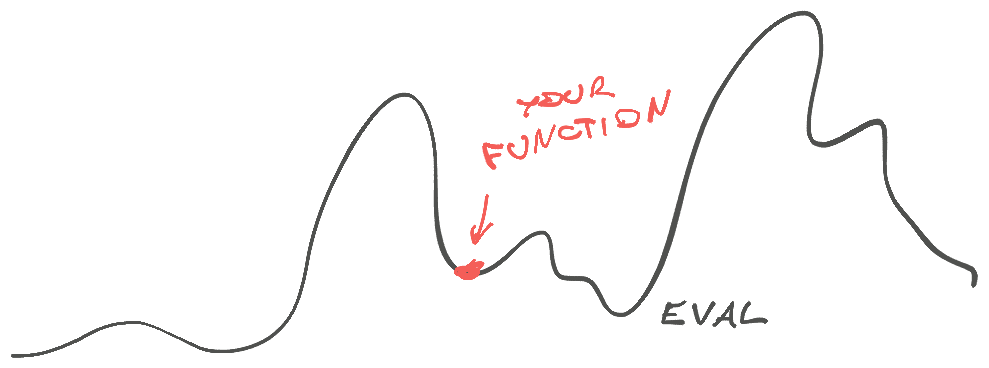
Decades of research have gone into different strategies to make this faster and less prone to getting stuck at a local optimum. You can look those up, it's a fun field :)
But measuring "correct" is hard. A perfect score on suggesting categories for 1 article is useless if it means zero hits everywhere else. And you get a different output on every run.
So we use precision to measure how many suggestions that the algorithm made actually match the dataset and recall to measure how many of the known categories it actually suggested.
F2, F1 and F0.5 are combined metrics that turn precision and recall into a single number with emphasis on recall, neither, or precision.
How that applies to prompt engineering
Normally you'd use hillclimbing to update weights in a model of some sort but you can apply the same technique at a higher level of abstraction – your prompt!
My blog category classifier works by taking a known list of categories and their descriptions then feeding that into a decision model alongside an article and asking, paraphrased, "What categories fit here?"
How I prompt engineered a useful category suggester
To build the category suggester I started with a dataset of a few hundred articles from my blog. Yay for regular publishing over the years!
There's been some category drift over the years so I focused on the past 5 years. That's 359 articles and fuck me if I can verbalize how categories are used. It's all been vibes-of-the-day two minutes before you hit publish 😅
So I asked Astra to analyze the articles and write a decision prompt based on what it looks like each category means when you try to understand the associated articles. It did okay.
We got a category-catalog with 130 categories, descriptions, and example articles.
As soon as I used that first version it felt off. The categories didn't vibe.
Now here's the cool part: I asked Astra "Hey this sucks, iterate on the prompt until it's good". And that worked 🤯
Astra split the dataset into 63 eval articles and ~300 it used to train the prompt. Then it hillclimbed for about 2 hours, kept tweaking the category catalog, and measured recall+precision on each iteration.
When that looked good, it used the 63 articles to give a final "how good we got" evaluation. This helps to prevent overfitting on the training set.
I can't show you how the prompt changed because I lost the diff in a rebase, but it looked almost random. Little variations in phrasing that to my human brain felt the same.
Upon reviewing the updated category catalog I found a few overlaps like leadership/management and compensation/salary where the dataset was more wrong than the prompt. Merged those and after another loop of hillclimbing the classifier improved from 51% to 71% precision. Huge success.
Now I want to try this to classify migrations as safe-to-merge or needs-review at work 😈
Cheers, ~Swizec
PS: some say the future of software engineering is to design evals and let your agents hillclimb towards a successful product. I don't know if that's true, the suits have been trying this for decades (OKRs etc) and it hasn't worked. You still need taste and direction, can't let math take the wheel.
Filed under: AIExperiment